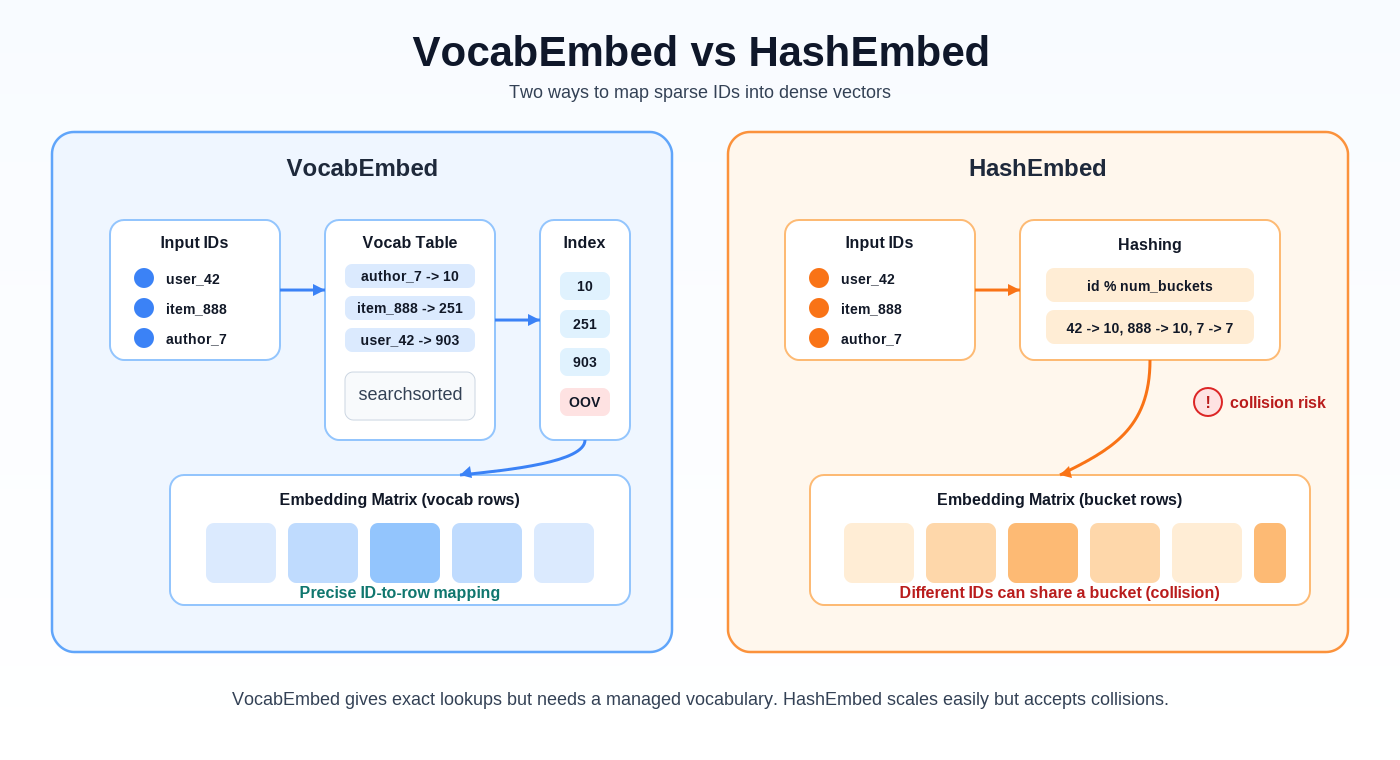
ID features (user_id, item_id, author_id) are high-cardinality categorical signals. Instead of one-hot vectors, which scale poorly and cannot capture similarity between IDs, embeddings are both efficient and expressive. The embedding mapping can be done with a fixed vocab with a out-of-vocab (OOV) embeddings, or through random hashing.
class VocabEmbed(nn.Module):
    def __init__(self, vocab: List[int], dim: int):
        super().__init__()
        self.register_buffer("vocab", torch.tensor(sorted(set(vocab))).long())
        self.emb = nn.Embedding(self.vocab.shape[0], dim)

    def forward(self, ids: torch.Tensor) -> torch.Tensor:
        ids = ids.long().to(device=self.vocab.device)
        pos = torch.searchsorted(self.vocab, ids)
        in_vocab = (pos < self.vocab.shape[0]) & (self.vocab[pos.clamp(max=self.vocab.shape[0] - 1)] == ids)
        if not torch.all(in_vocab):
            raise ValueError("ids contain values not in vocab")
        return self.emb(pos)


class HashEmbed(nn.Module):
    def __init__(self, num_buckets: int, dim: int, double_hash: bool = False):
        super().__init__()
        self.num_buckets = num_buckets
        self.double_hash = double_hash
        self.emb = nn.Embedding(num_buckets, dim)

    def hash(self, ids: torch.Tensor, second: bool = False) -> torch.Tensor:
        ids = ids.long()
        if not second:
            return torch.remainder(ids, self.num_buckets)
        # Second hash: bit-reverse in PyTorch, then hash to buckets.
        x = ids.to(dtype=torch.uint64)
        x = torch.bitwise_reverse_bits(x)
        return torch.remainder(x, self.num_buckets).long()

    def forward(self, ids: torch.Tensor) -> torch.Tensor:
        bucket_1 = self.hash(ids)
        if not self.double_hash:
            return self.emb(bucket_1)
        bucket_2 = self.hash(ids, second=True)
        return 0.5 * (self.emb(bucket_1) + self.emb(bucket_2))
Practical notes: 32/48/64 are commonly used embedding dimensions. Vocab can be generated daily or weekly from top IDs in the training data, set to a max limit, e.g. 0.5M, depending on the corpus size.